19+ Years Industry Experience
 Dedicated customer & tech support
 Easy 3 step booking process

 19+ Years Industry Experience
Dedicated customer & tech support
Easy 3 step booking process
19+ Years Industry Experience
Dedicated customer & tech support
Easy 3 step booking process


 Specialising in EICR surveys and related property services.
Over 19 years experience providing property surveys for all building types.
Contact us for free quotes and impartial advice.
Specialising in EICR surveys and related property services.
Over 19 years experience providing property surveys for all building types.
Contact us for free quotes and impartial advice.



An EICR (Electrical Installation Condition Report) is the formal way to check whether a property’s fixed electrical installations are safe. Think of it as an MOT for your property’s wiring. A qualified electrician inspects and tests everything from the consumer unit to the sockets, lighting circuits, and earthing arrangements, then reports on whether the installation is safe for continued use.
EICR is defined in BS 7671, the IET Wiring Regulations (18th Edition with Amendment 2, 2022) — the standard that governs all electrical installation work in the UK. You may also hear the older term Periodic Inspection Report (PIR) — some electricians still use it interchangeably, but EICR is the current correct terminology.
Not to be confused with: an EIC (Electrical Installation Certificate) is issued for brand-new installations or complete rewires — it certifies new work, while an EICR assesses existing work. PAT testing covers portable appliances (kettles, lamps, computers) rather than fixed wiring.
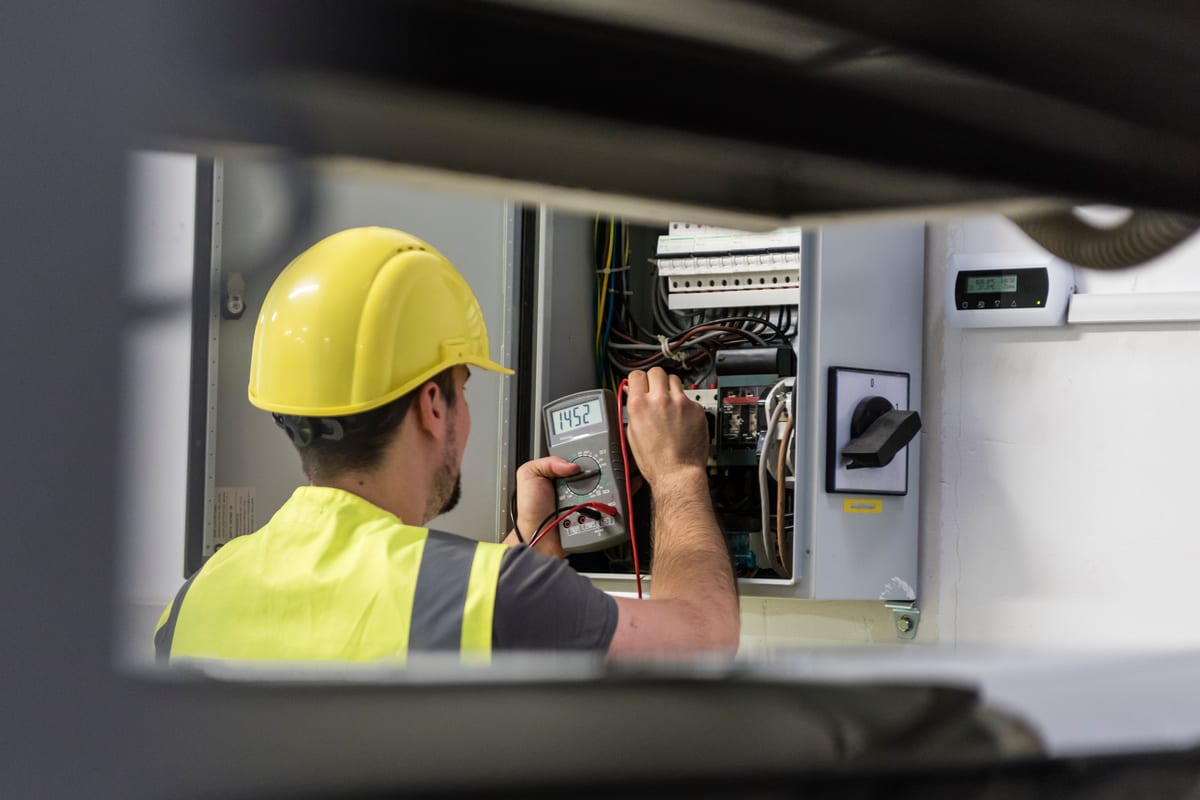
An EICR is a comprehensive assessment of every element of a property’s fixed electrical installation:
Consumer unit (fuse box) — physical condition and labelling; correct rating of MCBs and RCDs; presence and correct operation of RCD protection; adequate earthing at the main earth terminal; signs of overheating, arcing, or water ingress.
Circuits and wiring — insulation resistance (checks for cable insulation deterioration); continuity of ring final circuits; polarity checks; cable condition including damage, deterioration, or inappropriate cable types.
Earthing and bonding — main protective bonding to gas, water, and oil pipes; supplementary bonding in bathrooms and kitchens; earth fault loop impedance to verify the earth path can safely carry fault current.
Sockets, switches, and accessories — physical condition, mounting, secure fixings, adequate spacing, and appropriate ratings for the circuit.
RCD protection — trip times within specified milliseconds; correct sensitivity rating (typically 30mA for domestic); coverage across circuits.

How long it takes: 1.5–2.5 hours for a studio or 1-bed flat, 2–3 hours for a 2-bed house, 3–4 hours for a 3-bed house, 4–6 hours for 4–5 beds, up to a full day for large or complex properties. If an electrician promises a 3-bed inspection in under an hour, that is a red flag — proper testing cannot be safely rushed.
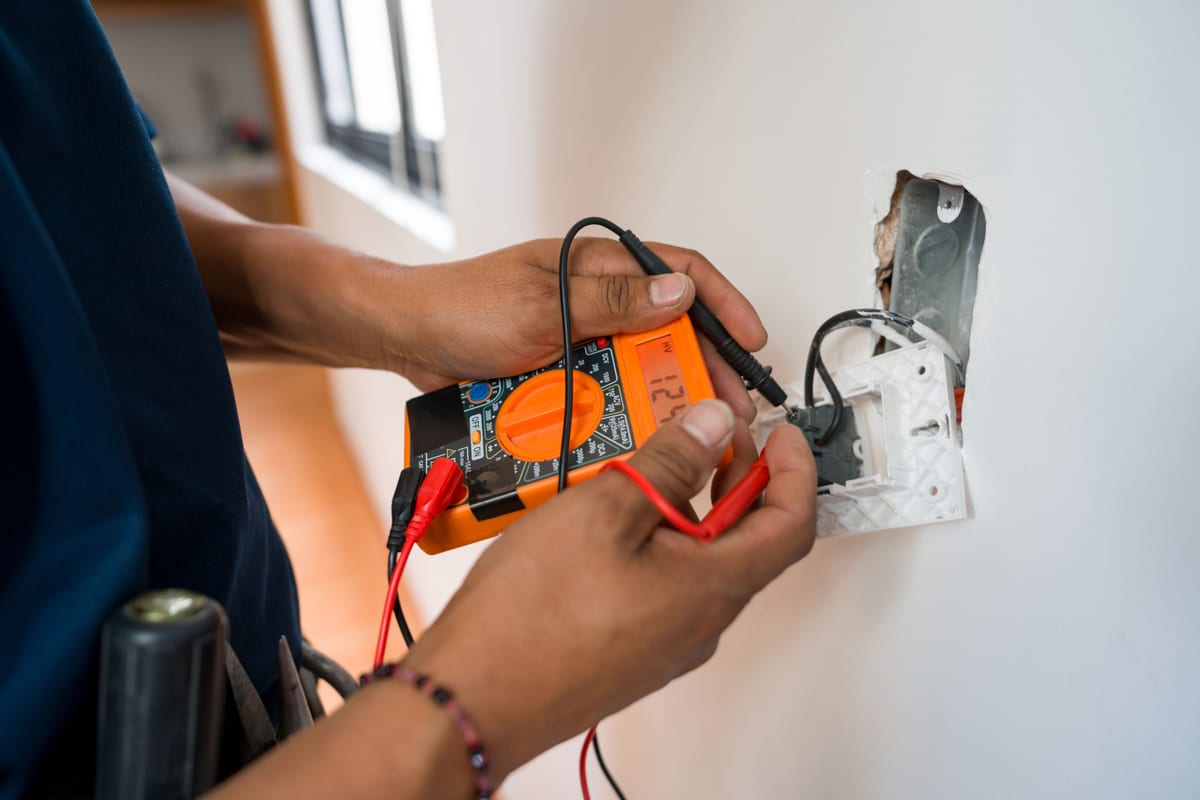
When an electrician finds an issue, they assign a classification code indicating its severity:
C1 — Danger Present. Immediate risk of injury exists. The inspector may disconnect or make safe the affected part before leaving. Action: immediately. Examples: exposed live conductors, overloaded circuits showing signs of overheating, absent or non-functional protective devices.
C2 — Potentially Dangerous. A fault that is not immediately dangerous but could become so. Action: remedial work within 28 days (or shorter if specified). Examples: missing RCD protection on a bathroom circuit, deteriorated cable insulation, incorrect fuse or MCB ratings.
C3 — Improvement Recommended. Does not fully meet current standards but is not dangerous. Remedial work is not required for the EICR to be Satisfactory. Examples: lack of supplementary bonding where already protected by RCD, older-style consumer unit still functioning safely, minor non-compliances with current edition of BS 7671.
FI — Further Investigation. The inspector cannot fully assess a particular element without further work. Investigation must be carried out promptly. Examples: inaccessible circuits, previous modifications obscuring the installation, inconclusive test results.
Satisfactory — no C1, C2, or FI codes. May have C3 codes (advisory only). Unsatisfactory — one or more C1, C2, or FI codes. Remedial work or investigation required. For a full breakdown see our detailed codes guide.

The 2020 Regulations require that EICRs are carried out by a “qualified and competent person.” In practice, this means an electrician with the appropriate inspection and testing qualifications — typically City & Guilds 2391 (Inspection and Testing) or an equivalent qualification.
Registration with a recognised competent person scheme is strongly recommended:
Verifying your electrician: ask for their competent-person scheme registration number and check it on the scheme’s website. A registered electrician will be happy to provide this — if they refuse or cannot, consider booking elsewhere. Unqualified inspections are not only unsafe, they may not be accepted by local authorities or insurers.
All Easy EPC EICR inspections are carried out by qualified, registered electricians with full City & Guilds 2391 certification and membership of recognised schemes.

Landlords — legally required before new tenancies and at least every 5 years in England under the 2020 Regulations. Social housing landlords must comply from November 2025 (new tenancies) and May 2026 (existing tenancies). In Scotland, EICRs have been mandatory since 2015. See our landlord EICR guide.
Homeowners — recommended every 10 years, or sooner if you are buying or selling, after major electrical work, if wiring is 25+ years old and never inspected, or if you notice problems (flickering lights, tripping RCDs, burning smells, discoloured sockets).
Businesses — every 5 years for offices, 3–5 years for commercial premises, 3 years for industrial, annually for high-risk environments (swimming pools, petrol stations). Required to demonstrate compliance with the Electricity at Work Regulations 1989. See our commercial EICR guide.
Insurance — insurers increasingly request proof of a valid EICR for older and rental properties. Without one, claims related to electrical faults may be disputed.
Property purchase — not legally required, but an EICR gives buyers confidence and is a useful negotiating tool. Costly remedial work (new consumer unit, partial rewire) can be addressed pre-completion or reflected in the sale price.
Not sure if you need one? Try our EICR Compliance Checker — answer four quick questions to find out.

EICR covers fixed electrical installations — wiring, sockets, switches, consumer unit, earthing, and bonding. Legally required for landlords under the 2020 Regulations. Frequency: every 5 years (rental), every 10 years (homeowners).
PAT testing covers portable appliances — anything with a plug that can be moved, such as kettles, lamps, computers, and washing machines. Not specifically mandated by standalone legislation in England, but expected under general H&S duties. Frequency varies by appliance type and environment.
They test completely different things and one does not replace the other. Landlords may need both: an EICR for the fixed installation and PAT testing for any appliances they provide. In Scotland, the Repairing Standard requires both as part of the same compliance obligation.
EICR vs EPC — an EICR checks electrical safety; an EPC rates energy efficiency. Different assessments, different professionals, both typically required for landlords. See our EICR vs EPC comparison.
See what landlords, homeowners and businesses say about working with Easy EPC.


EICR stands for Electrical Installation Condition Report. It is a formal inspection and test of a property’s fixed electrical installations, assessing their safety against BS 7671 (the Wiring Regulations). The EICR replaced the older Periodic Inspection Report (PIR) as the standard terminology.
“Electrical certificate” is an informal term often used to refer to an EICR. Technically there are several types — an EICR (for existing installations), an EIC (Electrical Installation Certificate, for new work), and a MEIWC (Minor Electrical Installation Works Certificate). When people say “electrical certificate” about a rental, they usually mean an EICR.
Someone needs to be present to grant access and to turn off sensitive equipment before power is disconnected. This can be you, a tenant, a letting agent, or a keyholder — it does not have to be the property owner.
Yes, temporarily. During dead testing, circuits are switched off one at a time. You will typically lose power to individual circuits for 15–30 minutes each. The electrician will coordinate to minimise disruption — testing kitchen circuits first so you can resume cooking, for example.
An EICR is classified as Satisfactory or Unsatisfactory — not technically pass/fail, but the effect is similar. If C1 (Danger Present), C2 (Potentially Dangerous), or FI (Further Investigation) codes are found, the result is Unsatisfactory and remedial work is required. C3 codes (Improvement Recommended) do not make the result Unsatisfactory.
Typically 1.5–2.5 hours for a studio or 1-bed, 2–3 hours for a 2-bed house, 3–4 hours for a 3-bed, up to a full day for large or complex properties. Rushed inspections are a red flag — proper testing cannot be safely shortened.
An EICR checks electrical safety; an EPC (Energy Performance Certificate) rates energy efficiency. Different assessments, different professionals — an electrician for the EICR, an energy assessor for the EPC. Most landlords need both.
Digital PDF by default; paper copies on request. Landlords must provide a copy to existing tenants within 28 days of the inspection and to prospective tenants before they move in.
Book an EICR in your city — from £99.95+VAT
Get a no-obligation quote for your domestic or commercial EICR. Our team will respond during opening hours.