19+ Years Industry Experience
 Dedicated customer & tech support
 Easy 3 step booking process

 19+ Years Industry Experience
Dedicated customer & tech support
Easy 3 step booking process
19+ Years Industry Experience
Dedicated customer & tech support
Easy 3 step booking process


 Specialising in EICR surveys and related property services.
Over 19 years experience providing property surveys for all building types.
Contact us for free quotes and impartial advice.
Specialising in EICR surveys and related property services.
Over 19 years experience providing property surveys for all building types.
Contact us for free quotes and impartial advice.


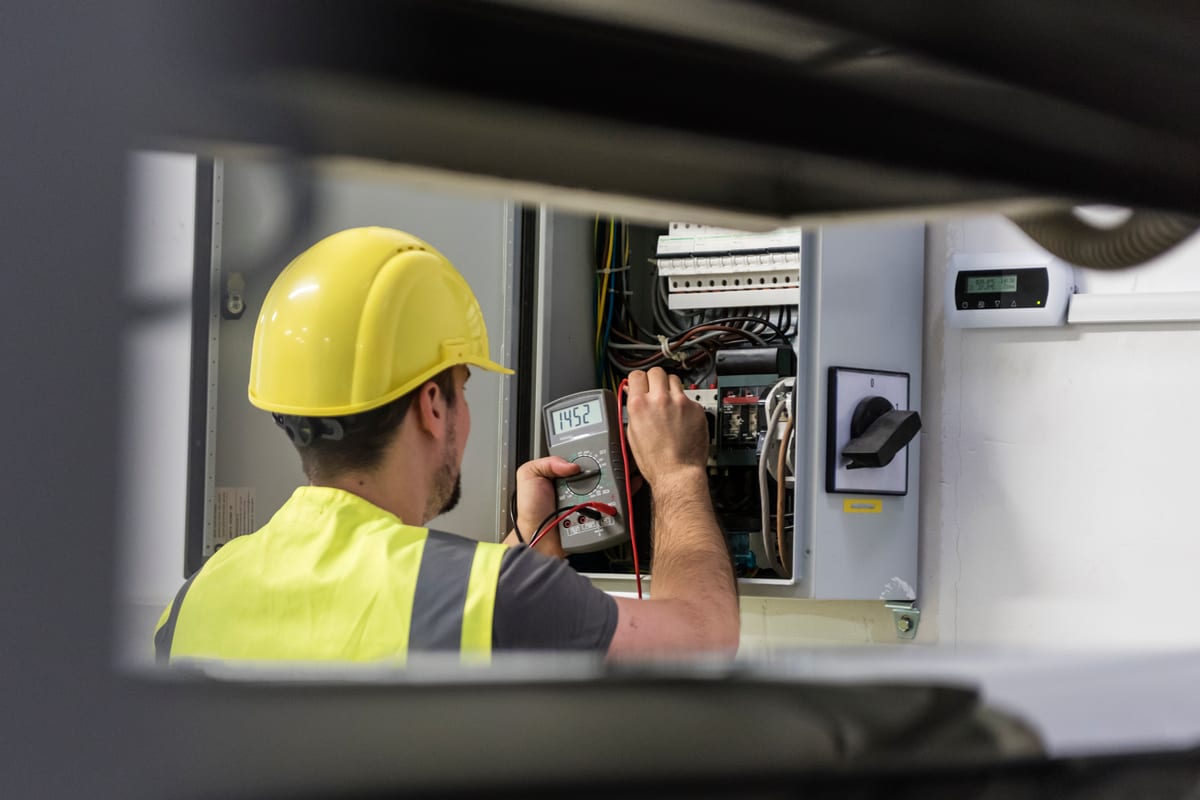
If you own or manage commercial premises, you have a legal duty to ensure the electrical installations are safe. An EICR is the standard way to demonstrate compliance with the Electricity at Work Regulations 1989. Offices, retail units, restaurants, warehouses, factories — a commercial EICR identifies potential electrical hazards before they become dangerous.
A commercial EICR follows the same methodology as a domestic EICR but covers larger, more complex installations: three-phase supplies, multiple distribution boards, specialist circuits for heavy machinery, high-power lighting systems, and commercial kitchen or industrial equipment.
Any business occupying commercial premises needs one. Insurers typically require a Satisfactory EICR every 3–5 years; licensing authorities demand one for HMOs, hotels, and licensed venues. We quote per site based on distribution board count and circuit volume.

The Electricity at Work Regulations 1989 require employers to maintain safe electrical systems. While they do not use the term “EICR,” periodic inspection to BS 7671 is the universally recognised method of compliance. The HSE, local authorities, and insurers all treat a current EICR as evidence of compliance.
Under the Health and Safety at Work Act 1974, employers must ensure the safety of employees (Section 2) and non-employees such as customers and visitors (Section 3).
Unlimited fines for non-compliance. Prosecution under the Electricity at Work Regulations or Health and Safety at Work Act can result in unlimited fines in the Crown Court. Directors can face personal criminal liability, including imprisonment.
Insurance implications. Insurance companies increasingly require evidence of electrical safety certification. If an incident occurs without a valid EICR, your insurer may reduce or reject the claim.
Need a commercial EICR? Get a commercial EICR quote — we cover offices, retail, hospitality, and industrial premises nationwide.
Recommended maximum intervals from BS 7671, Table 3.3:
| Premises type | Interval |
|---|---|
| Offices | Every 5 years |
| Retail | Every 5 years |
| Hospitality (hotels, restaurants) | Every 5 years |
| Industrial | Every 3 years |
| Warehouses | Every 5 years |
| Swimming pools | Every 1 year |
Industrial & warehousing. Three-phase experience is standard. We quote on circuit count and can sample-test large installations in line with BS 7671 guidance. Specialist circuits for machinery, process equipment, and heavy-duty power distribution may require additional time and expertise.
Offices & retail. Typical inspection is half a day. We work around your opening hours where possible; out-of-hours inspections available for businesses that cannot accommodate daytime disruption.
Your insurer confirms the specific interval required for your premises. Some policies mandate shorter intervals than the BS 7671 maximum.

Pricing depends on the number of circuits and complexity. Rates typically range from £10–£25 per circuit plus a base fee.
| Premises | Typical cost |
|---|---|
| Small office (up to 20 circuits) | £200–£400 |
| Medium commercial (20–50 circuits) | £400–£700 |
| Large / industrial (50+ circuits) | £700–£1,500+ |
| Retail unit | £250–£500 |
| Restaurant / hospitality | £350–£700 |
Prices cover inspection and testing. If remedial work is identified, it is quoted separately — fixed-price quotes for any C1/C2 items, issued alongside the report. See our full EICR cost guide.
Want to understand the report? See our EICR codes explained guide. For the remedial-work process and timelines after an Unsatisfactory result, see our EICR fail guide.
See what landlords, homeowners and businesses say about working with Easy EPC.

While the Electricity at Work Regulations 1989 do not specifically mandate an EICR by name, they require employers to maintain safe electrical systems. An EICR is the recognised standard method of demonstrating compliance. Without one, you would struggle to show you have met your legal obligations.
A small office with one distribution board might take 3–4 hours. A medium-sized unit could take a full day. A large warehouse or multi-floor building 1–3 days. We advise on expected duration when quoting.
Not necessarily. We work circuit by circuit to minimise disruption. For businesses where any downtime is critical, we offer out-of-hours inspections in the evenings and at weekends.
The testing methodology is the same (BS 7671), but commercial premises are more complex — larger installations, three-phase supplies, more circuits, and specialist equipment. The legal framework differs too (Electricity at Work Regulations 1989 vs the 2020 Private Rented Sector Regulations). See our landlord EICR guide for domestic requirements.
Every 5 years for most premises; 3 years for industrial, cinemas and leisure; 1 year for some high-risk environments (swimming pools, petrol stations). Your insurer will confirm the specific interval required for your policy.
Access to the distribution boards and a named point of contact. We handle the rest.
Yes — fixed-price quotes for any C1 or C2 items, issued alongside the report.
Yes — one project manager, one invoice, coordinated visits across sites.
Book an EICR in your city — from £99.95+VAT
Get a no-obligation quote for your domestic or commercial EICR. Our team will respond during opening hours.